How does a thermal camera work? The sensor that sees heat
Point a thermal camera at a dark room and you still see everything: the warm mug, the cold window, the dog asleep under the table. It isn't seeing light at all. It's seeing the heat that every object gives off on its own.
So how does a thermal camera work? Here's the answer, from the physics to the tiny sensor inside, and why the same physics explains what a thermal camera can't do, like seeing through a window.
Short answer: A thermal camera works by measuring the long-wave infrared radiation that every object gives off. A special lens focuses that radiation onto a grid of tiny heat-sensitive pixels, each acting as a separate thermometer. The camera turns those readings into a color picture, so it works in total darkness but can't see through walls.
How does a thermal camera work, step by step?
The whole process, which is what people mean by thermal imaging, repeats many times a second:
- Every surface gives off infrared radiation. The warmer it is, the more it gives off.
- The lens focuses that radiation onto the sensor. It can't be ordinary glass, for reasons we'll come to.
- Each pixel warms very slightly, and its electrical resistance changes.
- The electronics measure that change for every pixel and turn it into a temperature reading.
- The app paints the numbers in colors, so you see a picture instead of a grid of figures.
| Normal camera | Thermal camera | |
|---|---|---|
| What it records | Light reflected off objects | Radiation objects emit themselves |
| Needs light? | Yes | No |
| Lens | Glass | Germanium or chalcogenide glass |
| Sensor | Millions of pixels | Thousands or tens of thousands |
| What the picture means | Color and brightness | Surface temperature |
The rest of this guide takes those steps one at a time.
Why does everything give off heat you can't see?
Every object warmer than absolute zero gives off electromagnetic radiation. A glowing stove element gives off enough at short wavelengths for us to see. Things at everyday temperatures give off far less, at much longer wavelengths in the infrared, where our eyes can't follow.
Two rules decide what that radiation looks like:
- Warmer means more. The total energy an object radiates rises very steeply with temperature (with the fourth power of its absolute temperature). A small temperature difference means a measurable difference in radiation.
- Warmer means shorter. The peak wavelength moves shorter as things get hotter. A wall at room temperature radiates most strongly at around 10 micrometers (µm). Human skin peaks a little shorter, around 9.5 µm.
A normal camera records light reflected off objects from the sun or a lamp. A thermal camera records the radiation the objects emit themselves. That's why it works in total darkness, and why a mug of coffee and a glass of ice water that look alike in a dim kitchen look completely different through it.
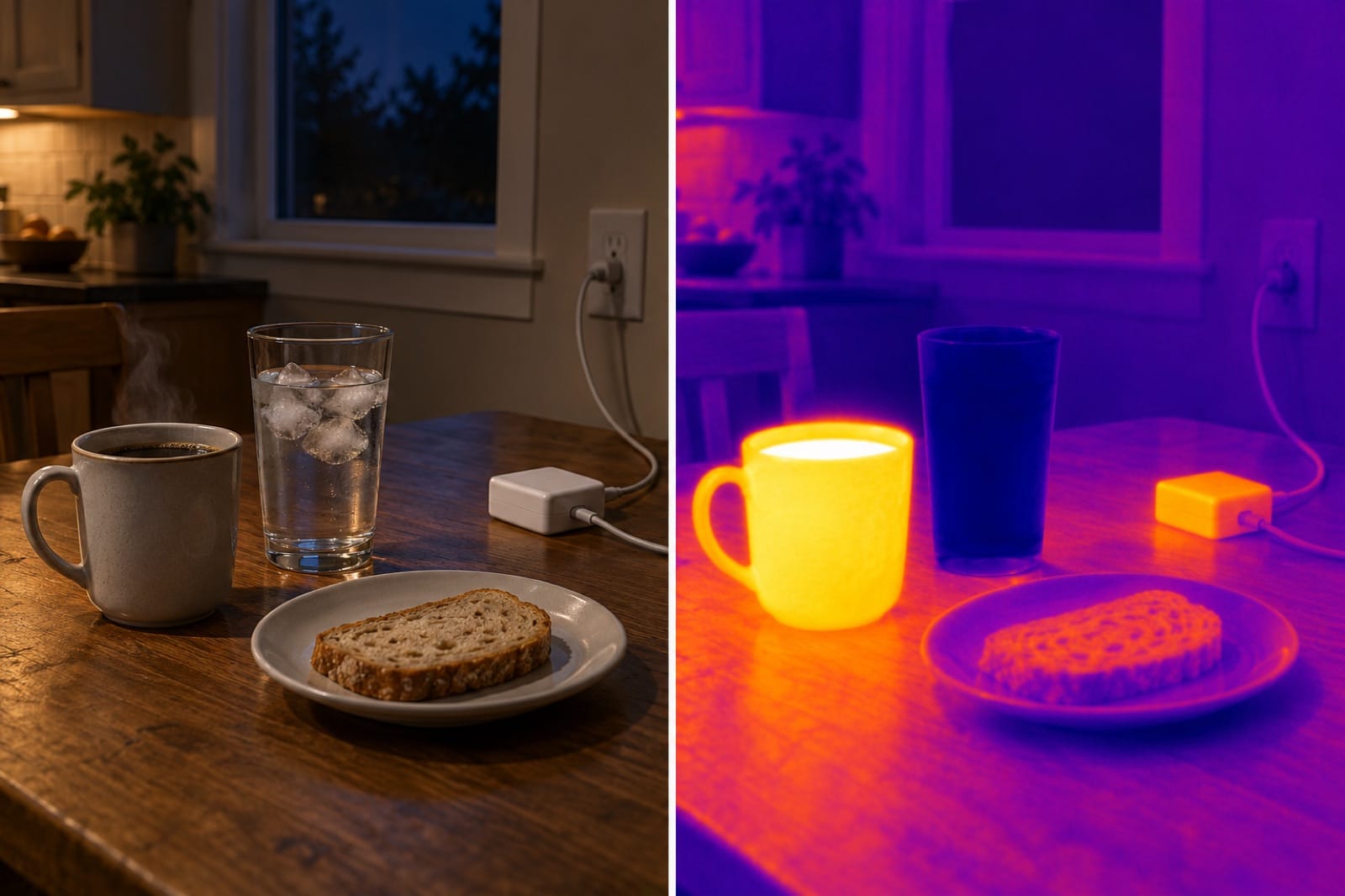
Illustration: in dim light the two drinks look alike; through a thermal camera they couldn't be more different. The ice inside the glass doesn't show, because the camera only sees the glass's outer surface.
Why do thermal cameras use long-wave infrared, 8–14 µm?
Most thermal cameras for buildings and everyday use work in the long-wave infrared band, from about 8 to 14 µm. There are two good reasons.
First, that's where objects at room and body temperature radiate most strongly, so there's plenty of signal. Second, air lets this band through. Water vapor and carbon dioxide absorb many other infrared wavelengths, but 8–14 µm falls in a gap called an atmospheric window, so the camera sees across a room or a backyard without the air getting in the way.
Night-vision gear and the "IR" mode on security cameras are different: they work in the near infrared, just beyond red light, and still need light from the moon or an infrared lamp to bounce off things. A thermal camera needs no light at all. Our comparison of thermal cameras, night vision and IR thermometers goes further into that difference.
Why isn't a thermal camera lens made of glass?
Ordinary glass is transparent to visible light but opaque to long-wave infrared. To a thermal camera, a glass lens would be a solid wall. So thermal lenses are made from materials that let 8–14 µm through:
- Germanium, a gray, metallic-looking element. A germanium lens looks like a polished piece of dark metal, and you can't see through it, but to long-wave infrared it's clear.
- Chalcogenide glass, a family of special glasses made from elements like germanium, arsenic and selenium. They also transmit long-wave infrared and can be molded into shape, which helps make small, affordable lenses.
That's why the front of a thermal camera shows a small, dark, almost opaque window instead of a clear lens. These materials cost far more than glass, one reason thermal cameras cost more than ordinary cameras.
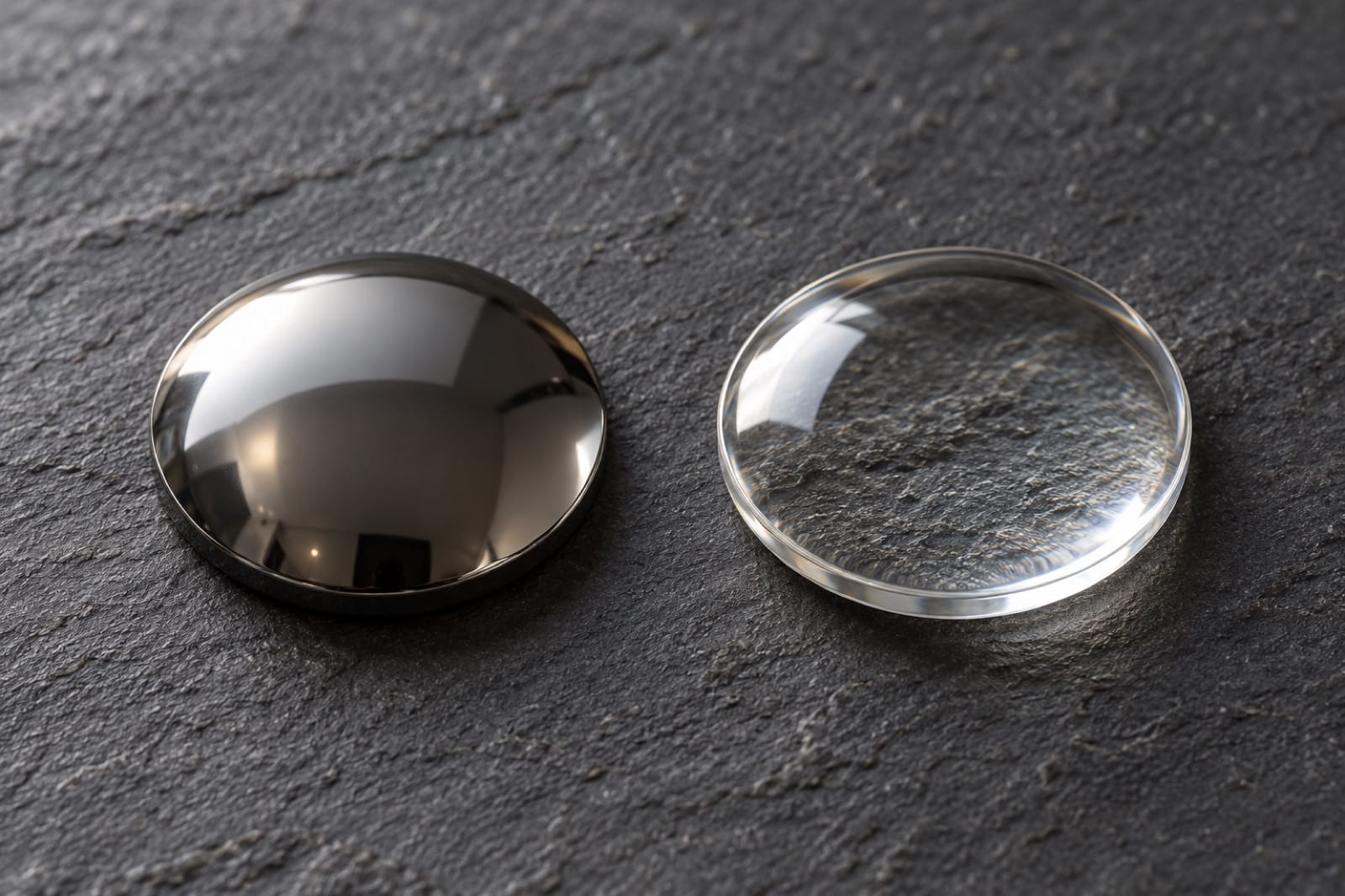
Illustration: the germanium lens (left) looks like polished metal, but it's clear to long-wave infrared. The glass lens (right) is clear to our eyes and blocks it.
What is a microbolometer?
Behind the lens sits the part that made affordable thermal cameras possible: the uncooled microbolometer, in effect thousands of tiny thermometers on a chip.
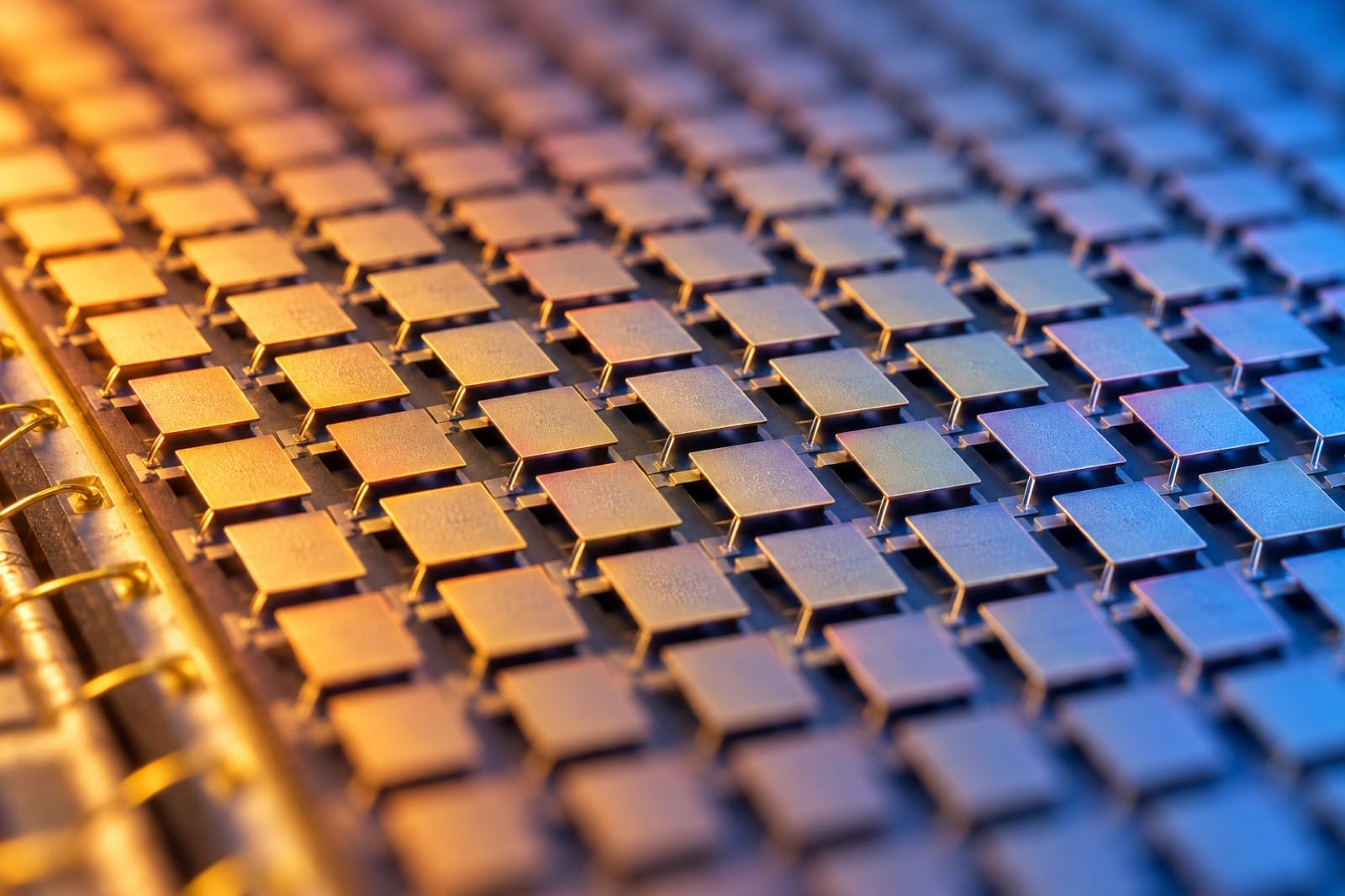
It's a grid of tiny pixels on a silicon chip. Each pixel is a thin membrane, typically made from vanadium oxide or amorphous silicon, held up on two thin legs just above the chip so it touches almost nothing. The whole grid sits in a sealed vacuum package, so the air doesn't carry heat away.
When infrared from the scene lands on a pixel, the membrane warms very slightly, its electrical resistance changes, and the circuit underneath measures that change for every pixel, many times a second. Each pixel is effectively a separate thermometer.
Two consequences of this design:
- Thermal pixels are big and few. A useful pixel can't be much smaller than the wavelength it detects, and long-wave infrared is about ten times longer than visible light. So thermal pixels typically measure 12–17 µm across, while phone camera pixels measure around a micrometer. That's why a thermal sensor has thousands or tens of thousands of pixels, not millions.
- Many thermal cameras click. The sensor's own temperature drifts, and every pixel responds slightly differently. To correct for that, many cameras briefly close a small shutter in front of the sensor, which gives every pixel the same uniform reference to recalibrate against. That's the occasional click and short freeze you may notice. It's normal.
Cooled and uncooled
Military, scientific and some industrial cameras use cooled detectors, kept at cryogenic temperatures. They're faster and more sensitive, but bulky and expensive. Microbolometers need no cooling, and over the years they got small and cheap enough to plug into a phone.
How does the signal become a temperature?
The sensor measures how much infrared reaches each pixel. Turning that into a temperature takes one more piece of information: how well the surface gives off radiation, called its emissivity.
Matte paint, drywall, wood, brick, fabric and skin have an emissivity of around 0.95: they radiate nearly as much as a perfect emitter and reflect very little. Polished metal can be below 0.1: it radiates little and reflects most of what falls on it. The camera assumes a value (usually around 0.95), so it reads matte surfaces well and shiny ones badly: a polished pipe often looks far colder than it is.
The colors are added last: the camera produces a grid of numbers, and the app paints them in a palette such as ironbow, purple for cold and yellow-white for hot. In automatic mode the palette stretches between the coldest and hottest point in the frame, so the same color can mean different temperatures in two pictures. That's also why the camera is best at differences ("this spot is 2 °C colder than the rest") rather than exact numbers on shiny surfaces. Our guide to reading a thermal image goes through the practical side of reflections, emissivity and color scales.
Can a thermal camera see through walls or glass?
No. The same physics sets the limits:
- Walls. Infrared doesn't pass through drywall, brick or wood. The camera sees the temperature of the surface. A pipe or a wet patch inside a wall shows up only because it warms or cools the surface in front of it.
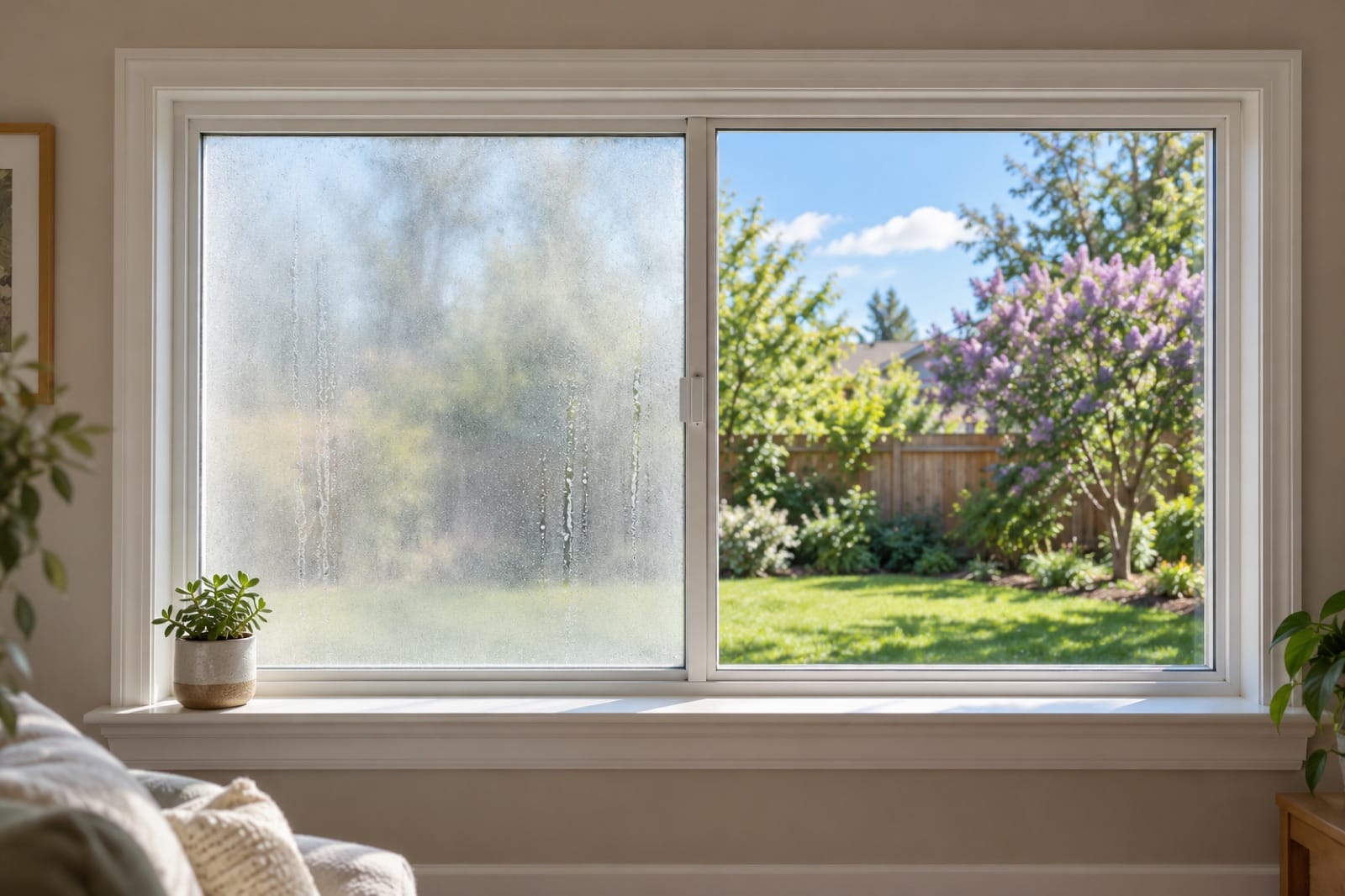
- Window glass. Glass is opaque to long-wave infrared, so through a window you see the glass's own temperature plus reflections, often a warm blur that is you. You can't use a thermal camera to look out of a window or into a car.
- Water. Water absorbs long-wave infrared strongly, so you see only the temperature of its surface, never what's below.
- Some plastics are the surprise. Thin polyethylene, such as a black trash bag, lets a good part of long-wave infrared through. A thermal camera can show a warm hand inside a black bag, while it can't see through a clear window.
- Smoke. Long-wave infrared passes through smoke far better than visible light, which is why firefighters use thermal cameras.
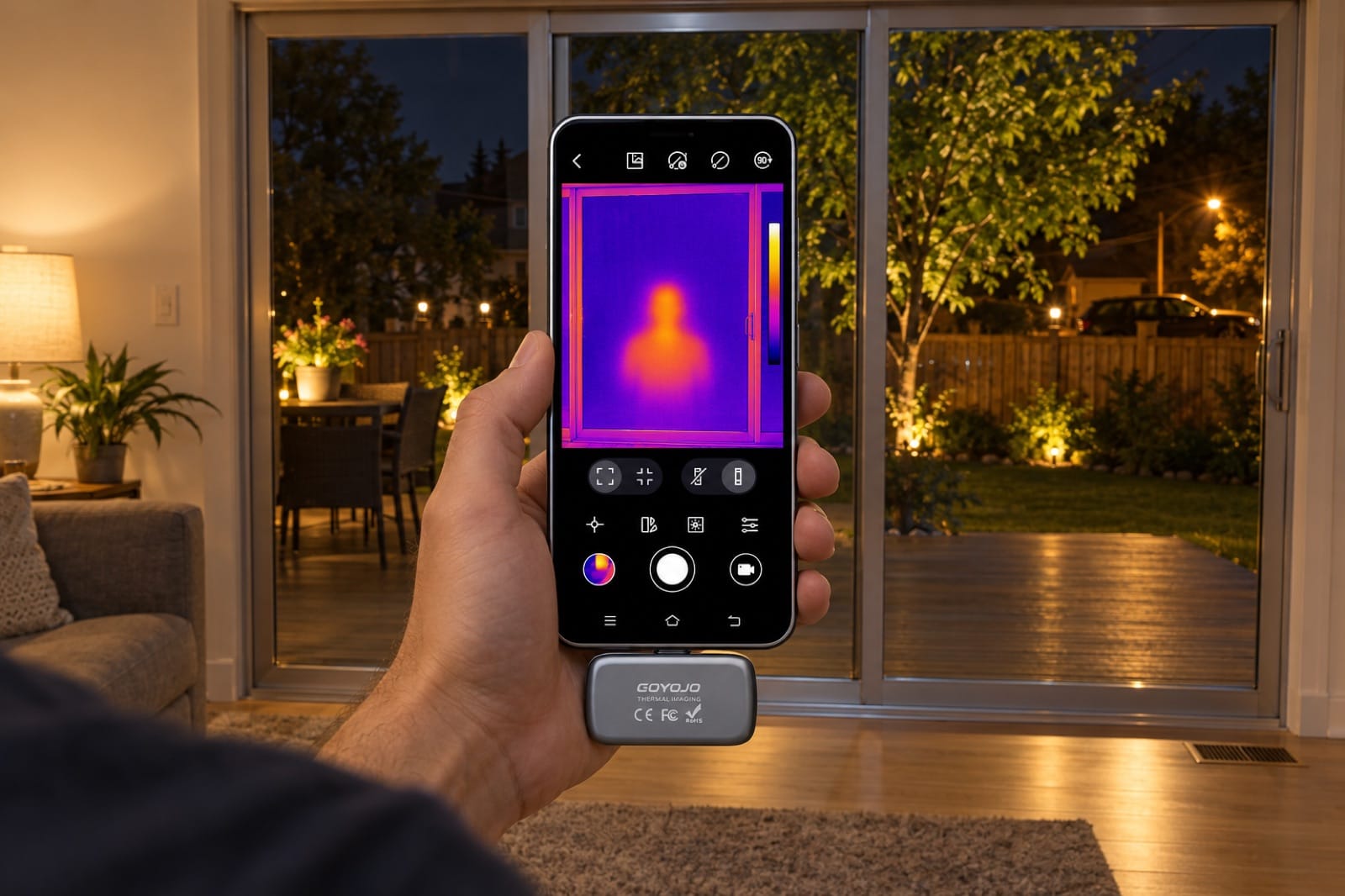
Illustration: the yard is clearly visible through the glass to your eyes, but the thermal camera sees only the glass itself and a warm reflection of the person holding the phone.
The thermal cameras we sell
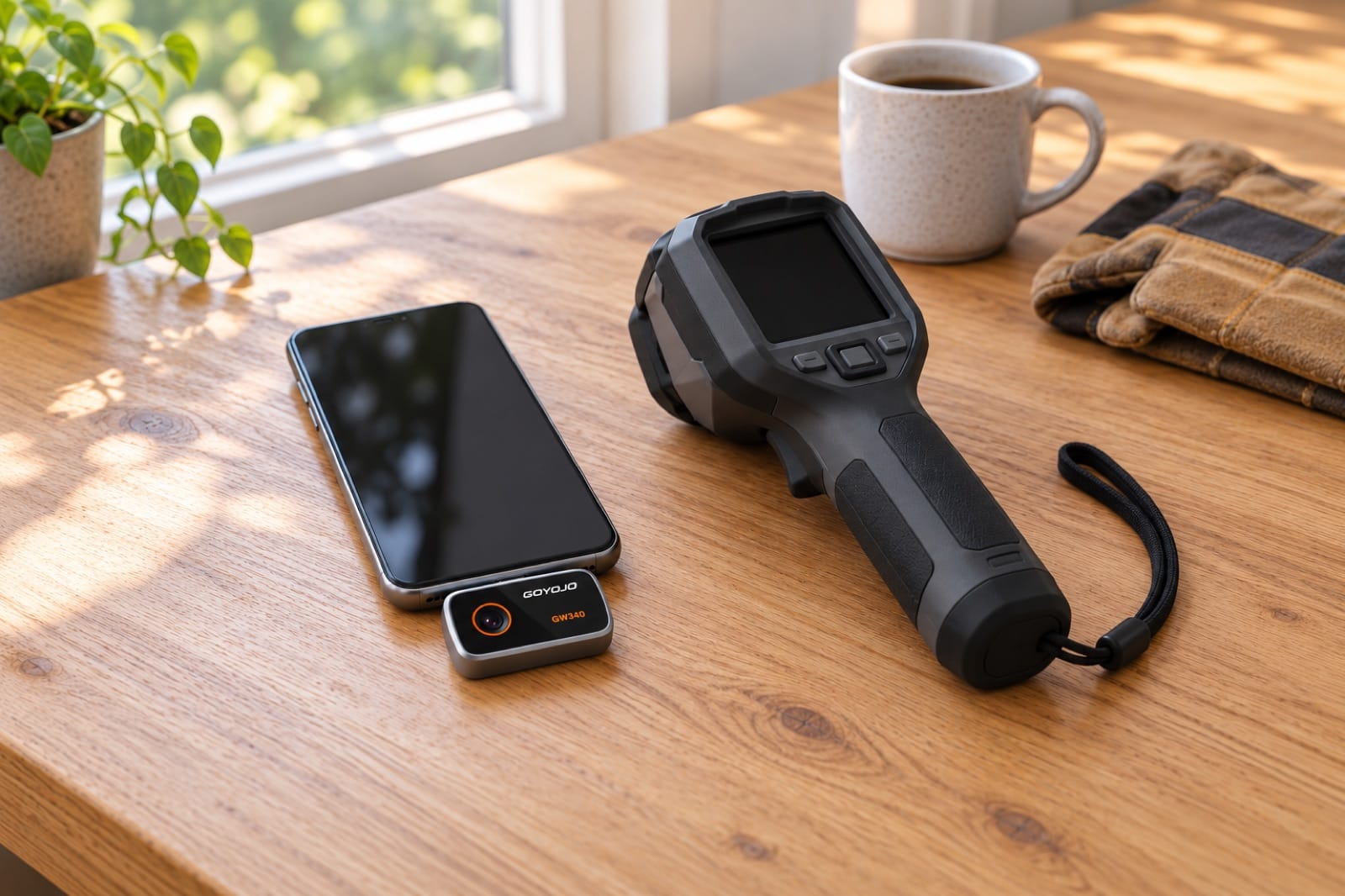
Both of ours are uncooled microbolometer cameras that plug into a phone's USB-C port; the phone supplies power, the screen and the app.
- Spark Pro has a 256 × 192 sensor, about 49,000 separate temperature readings per frame, with 50 mK thermal sensitivity (its noise level is about 0.05 °C, so very small differences still show) at 25 frames per second. The app can show an enhanced 512 × 384 image, but the measurements come from the 256 × 192 pixels.
- Spark has a 96 × 96 sensor, about 9,200 readings, which the app smooths to 192 × 192. Same colors, same app, best when you work close to the surface.
What that difference means in a real house is in our Spark vs Spark Pro guide. If you use an iPhone, start with the thermal camera for iPhone guide. For where thermal fits next to other tools, see thermal camera, moisture meter or inspection camera.
Frequently asked questions
Why do we use thermal cameras?
Because temperature differences reveal problems that are invisible to the eye. In a house, that means cold patches from missing insulation, warm lines from hot water pipes, and overheating outlets or power strips. The same idea is used to inspect electrical equipment and machinery, by firefighters looking through smoke, and to spot animals and people at night. The camera finds the spot, and a closer look usually explains it.
What are the downsides of thermal imaging?
Resolution is much lower than a normal camera, so small or distant things can blur together. Shiny surfaces reflect heat and give misleading readings. It also needs a temperature difference: when everything is the same temperature, there's little to see. And it only shows surfaces, so it suggests where a problem might be rather than proving what it is. That usually takes a second check.
Can someone see inside my house with a thermal camera?
No. A thermal camera can't see through walls or windows, so it can't show people or objects inside a house. From outside, it shows only the temperature of the outer surfaces: warm spots where heat is escaping, for example. Glass reflects heat, so pointing one at a window mostly shows the glass and reflections. Night vision can see through a window, but it needs some light to work.
Will a snake show up on thermal imaging?
Sometimes. Snakes don't produce much body heat of their own, so their temperature tends to follow their surroundings. A snake shows up only when it's warmer or cooler than what's around it, such as one that has been basking on a warm rock and then moved to cooler ground. If it has been in the same spot for a long time, it can be hard to see.
Is it legal to have a thermal camera?
Owning a thermal camera for home use is generally legal, though rules vary by country and can be stricter for high-end models and for taking them across borders, so check locally if you're unsure. How you use it matters too. Inspecting your own home is one thing, while pointing a camera at other people's property can raise privacy issues.
The tools in this guide
Prices are on each product page, in your local currency.
- Spark Pro — 256 × 192 thermal pixels, 50 mK, −20 to 350 °C.
- Spark — 96 × 96 thermal pixels, −20 to 400 °C.
Ready to see heat for yourself? Order Spark Pro, or get the Whole Home Kit with the Damp moisture meter and the Reach 360 inspection camera for 10% less than buying them separately.