Spark or Spark Pro? How to choose a phone thermal camera
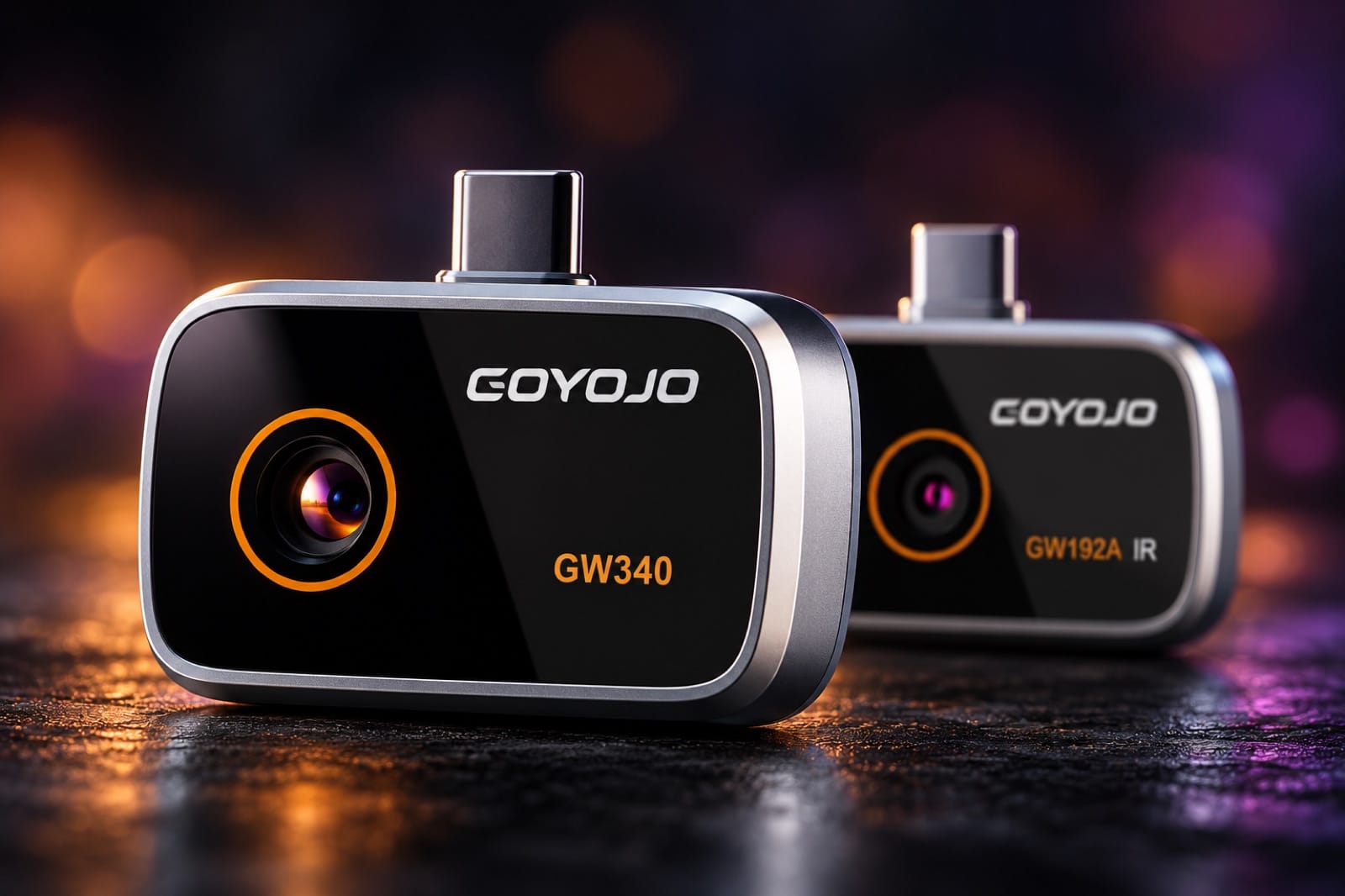
Both of our thermal cameras plug into the bottom of a USB-C phone, use the same free app and show the same colours: purple for cold, yellow and white for hot. The difference is how many temperature points each one measures — and that decides how far away you can stand and still see the thing you're looking for.
Here's how to choose without paying for detail you won't use, or saving A$150 and missing the pipe.
The one number that matters: thermal pixels
A phone camera has millions of pixels. A thermal camera has thousands, and each one is a separate temperature reading.
- Spark (GOYOJO GW192A) has a 96 × 96 sensor: about 9,200 readings. The app smooths it to 192 × 192 on screen.
- Spark Pro (GOYOJO GW340) has a 256 × 192 sensor: about 49,000 readings, more than five times as many.
Both see a 50° wide view. Spread that over a wall two metres away and each Spark pixel covers a square about 2 cm wide; each Spark Pro pixel covers about 7 mm.
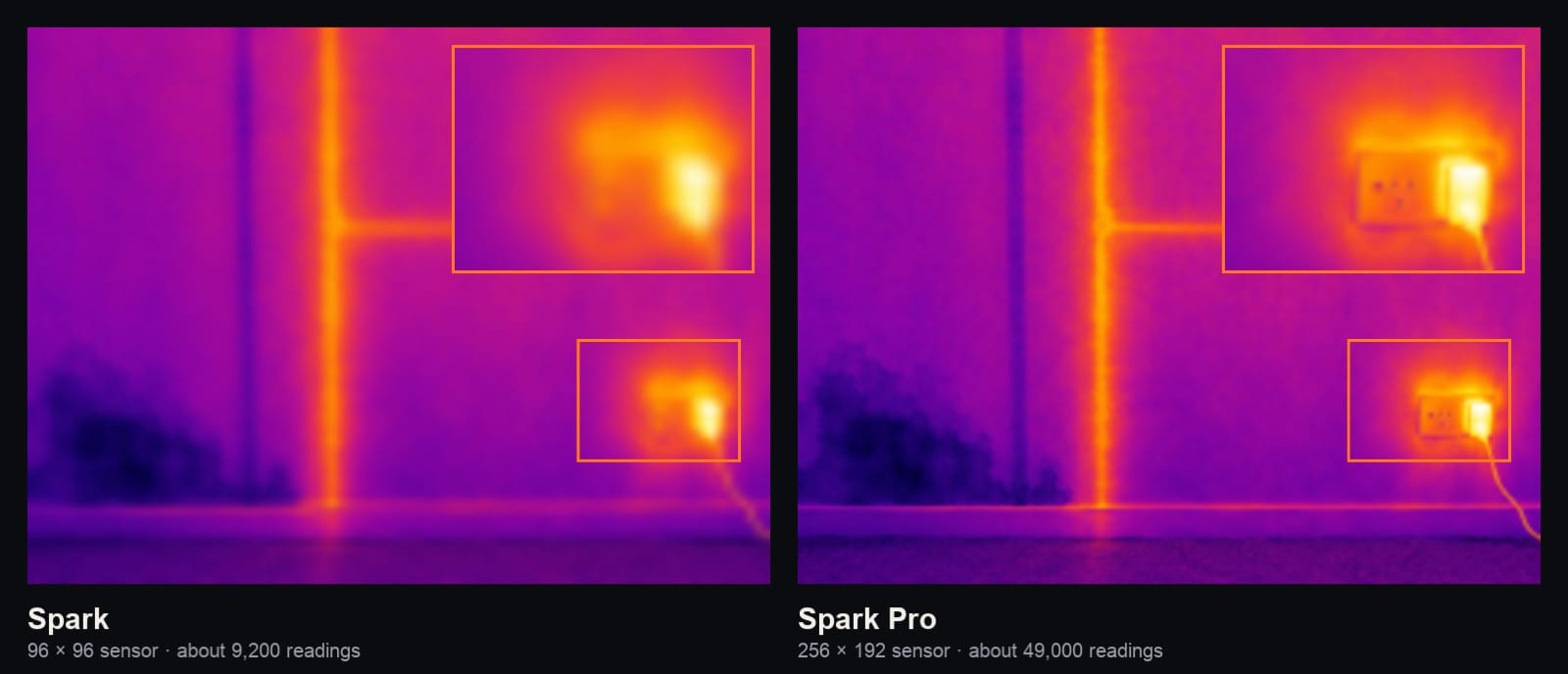
Simulation: one thermal scene reduced to each sensor's resolution. The damp patch and the pipes show on both. In the close-up, Spark sees a warm blob; Spark Pro sees the power point and which plug is hot.
What that means in a real house
A rule of thumb thermographers use: an object needs to cover about three pixels before the reading on it can be trusted. Put that against the things you actually look for at home.
| What you're looking for | Typical size | Spark: stand closer than | Spark Pro: stand closer than |
|---|---|---|---|
| Copper water pipe in a wall | 15 mm | about 0.5 m | about 1.4 m |
| Wet patch from a slow leak | 20–40 cm | 6–10 m | 15 m+ |
| Missing ceiling batt | 40 × 120 cm | the whole room | the whole room |
| Gap under a door or around a window | 5–10 mm line | about 0.2 m | about 0.8 m |
| Hot plug, powerboard or charger | 1–3 cm | 0.3–1 m | 1–3 m |
Big, soft targets — a damp patch, a ceiling with no insulation, a radiator that only heats half way — show up clearly on both. Thin, small things — one pipe, a crack, a loose terminal, a draught line — need either Spark Pro or getting your nose right up to the wall with Spark.
That matters more than it sounds. Standing close means you see one tile at a time and have to scan a wall in strips. From two metres back, Spark Pro shows the whole wall in one frame, and the pipe running through it.
Choose Spark if…
- You have one job in mind: a damp corner, a bathroom wall, checking a cold spot by a window.
- You rent and want to show the agent or landlord a photo of the problem.
- You want to check plugs, chargers and appliances you can hold up close.
- A$199 is the budget. It's a real thermal camera, not a toy — it just needs you closer.
Choose Spark Pro if…
- You want to scan the whole house: walls, ceilings, floors, every room.
- You're buying a house and get 20 minutes during an open home.
- You're tracing pipes, underfloor heating or cables before you drill.
- You'll be looking up at ceilings — missing insulation, roof leaks, wet patches around downlights — where you can't get close.
- You want the sharper photo to send to a plumber, electrician, builder or insurer.
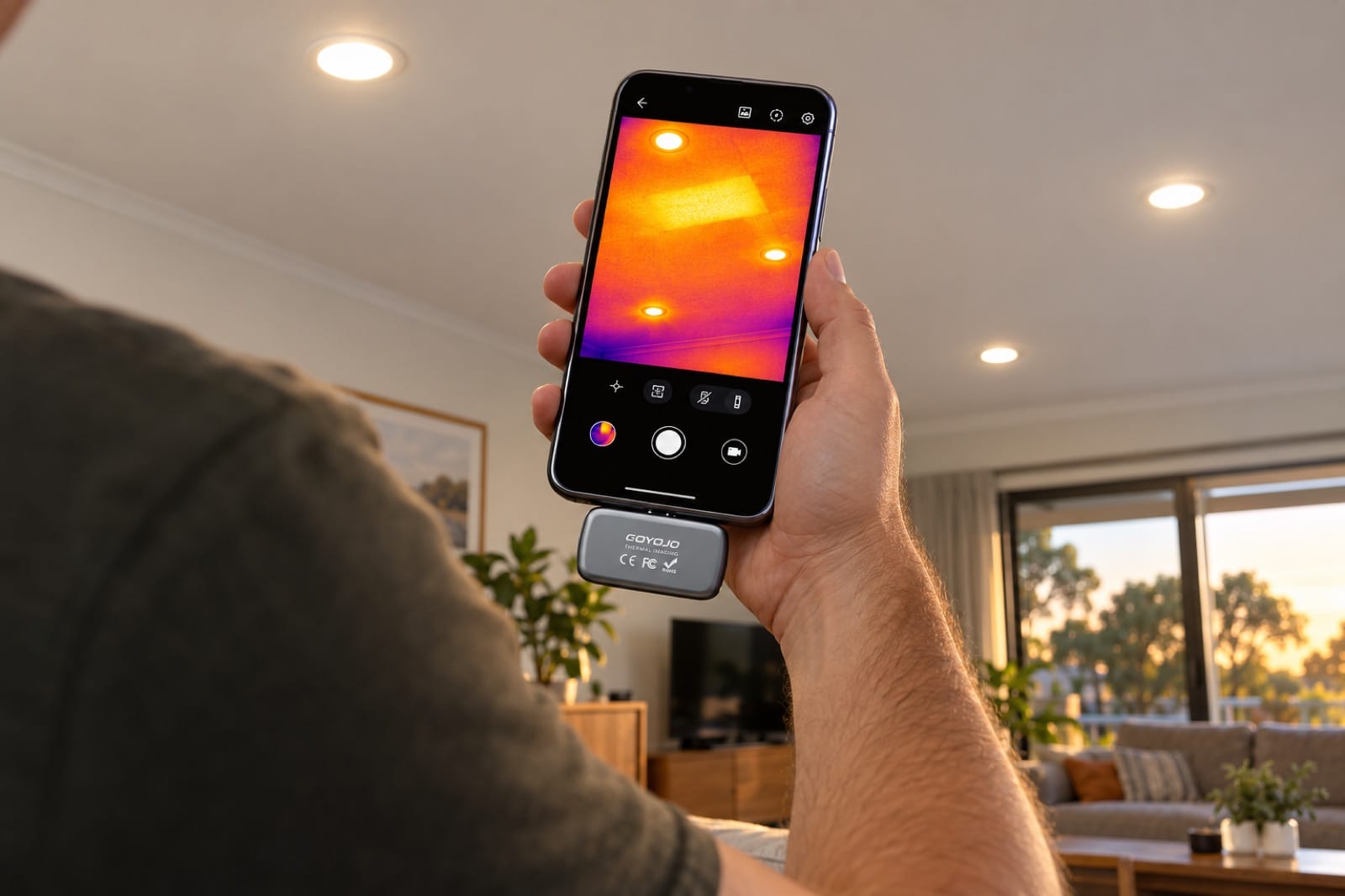
Illustration: on a hot afternoon a gap in the ceiling insulation lets roof heat through — from the floor, without climbing into the roof.
What neither of them does
Worth saying plainly, because some ads promise more:
- They don't see through walls. They read the temperature of the surface. Something inside the wall shows up only when it warms or cools the surface in front of it.
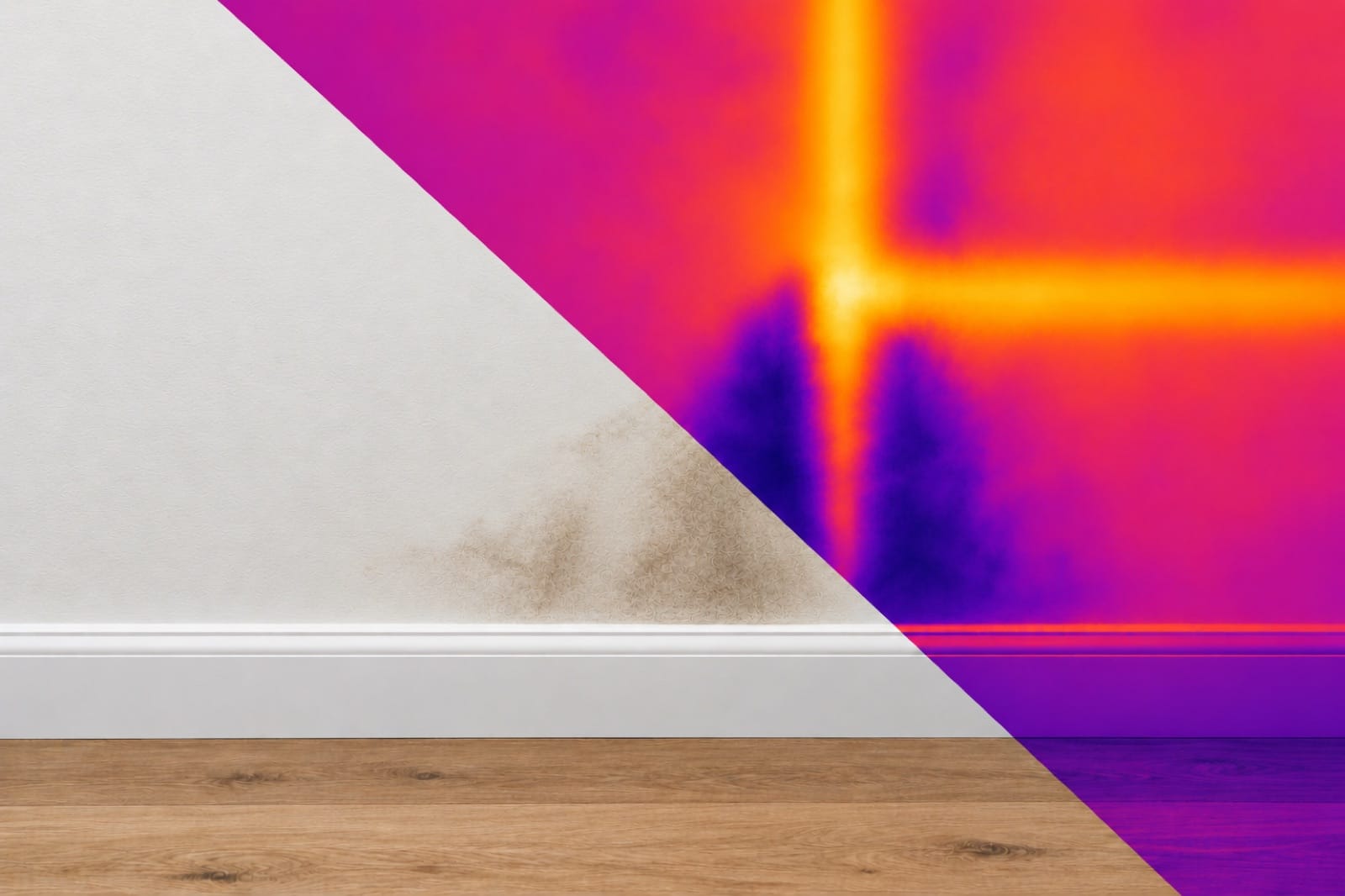
- They don't see water. Wet plaster usually reads cooler because the water is evaporating; that's what you're seeing.
- Shiny surfaces lie. Glass, tiles, stainless steel and foil reflect heat like a mirror reflects light, so you may be measuring your own reflection. Read the grout or a piece of tape stuck on the surface instead.
- You need a temperature difference. On a mild day with the windows open, a wall can look almost uniform. Run the hot tap, turn on the heater or air-con, or scan early in the morning.
Combine it with a second tool
A thermal camera answers "where?". It rarely answers "what?". That's why it works best as the first of two or three steps:
- Thermal camera finds the spot that's colder or hotter than it should be.
- Damp moisture meter tells you whether that spot is actually wet, or just cold.
- Reach 360 inspection camera goes through a small hole or an existing gap to show you the pipe, the joint or the timber.
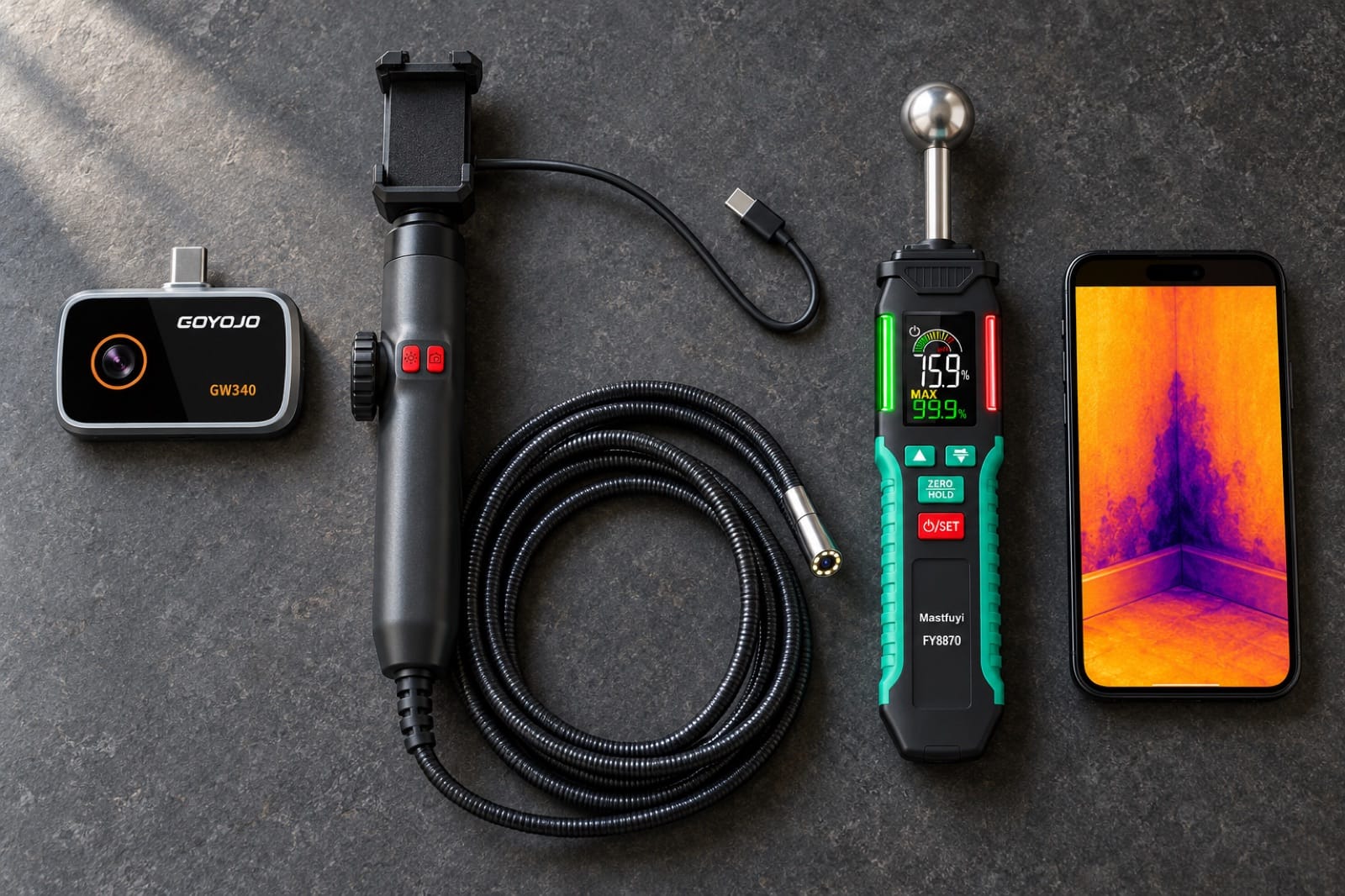
Illustration: Spark Pro finds it, Damp proves it's wet, Reach 360 shows you inside.
We sell those three together as the Whole Home Kit, with Spark Pro as the thermal camera, for A$48 less than buying them separately.
Will it fit my phone?
Both plug into USB-C. That covers Android phones from roughly the last five years (Android 12 or later) and iPhone 15 Pro to iPhone 17. iPhone 14 and older use Lightning and won't work. The maker doesn't list the base iPhone 15 or iPhone 18 yet — if you have one, email us before you order.
The short version
- One wall, one problem, close up → Spark, A$199.
- Whole house, ceilings, pipes, buying or selling → Spark Pro, A$349.
- Want to find it, prove it's wet and look inside → Whole Home Kit.