A pinless moisture meter for walls and floors
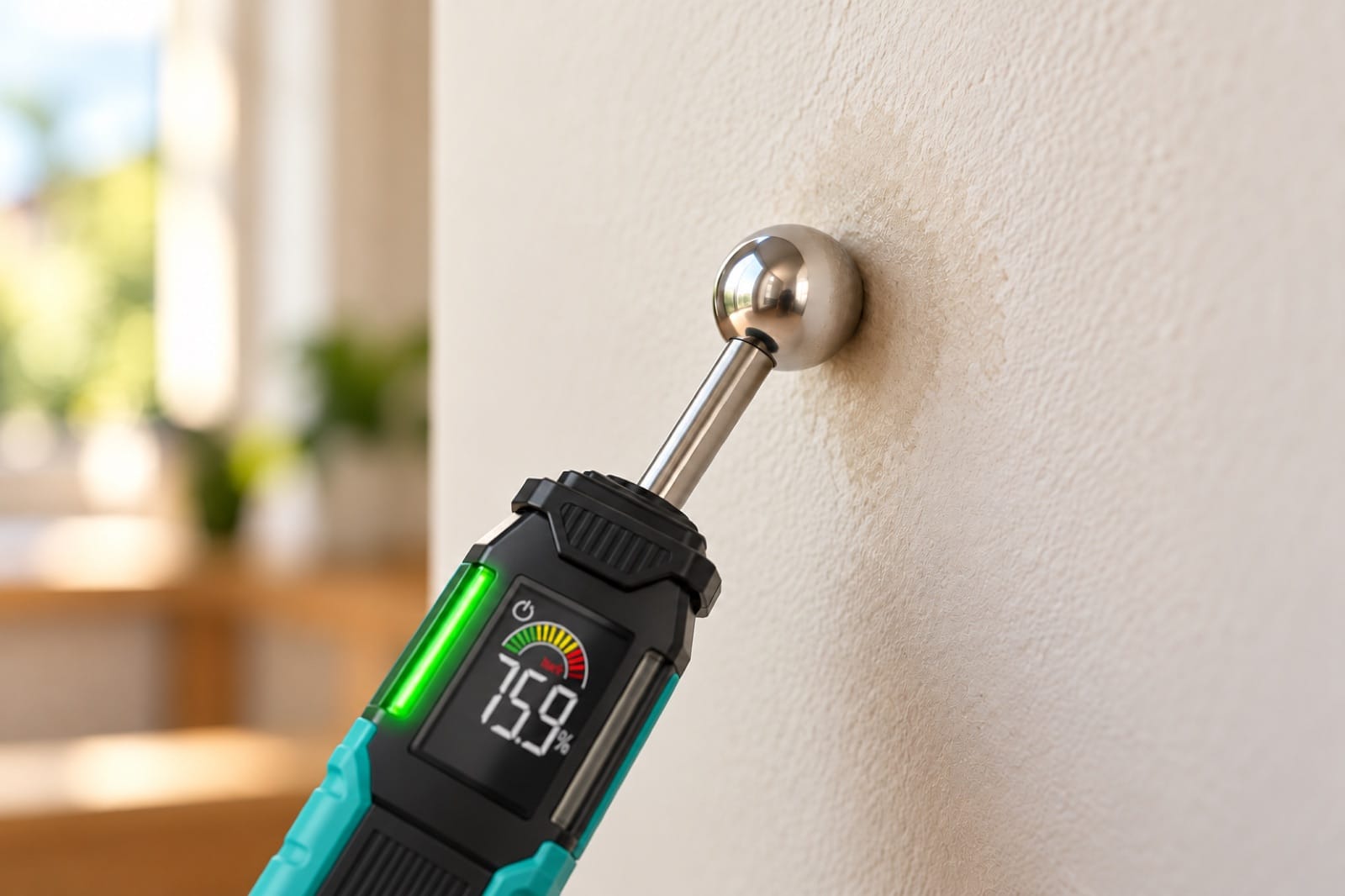
A thermal camera shows you where a wall is colder than it should be. A moisture meter tells you whether that cold patch is actually wet. Damp does it without pins: touch the ball to the wall and read the number.
A pinless meter reads moisture under the surface without making holes. Damp's ball probe reads 5–40 mm (about ¼–1½ in) deep in plaster, cement and wood, so you can trace a leak to its source and check that a wall has dried after a repair. Read it as a comparison — the wet spot against a dry part of the same wall.
How a pinless meter works
A pin meter pushes two metal pins into the material and measures the current between them. A pinless meter sends a small electrical field into the material instead. Water changes how that field behaves, so the number goes up where the material is wetter — and nothing gets punctured.
Damp's probe is a metal ball, so it's easy to use on a wall, along a baseboard, on a floor or around a tub.
Pin or pinless?
| Pin meter | Pinless (Damp) | |
|---|---|---|
| Holes in the surface | Two small holes per reading | None |
| Where it reads | At the depth of the pins | 5–40 mm (about ¼–1½ in) under the surface |
| Scanning a whole wall | Slow — one point at a time | Fast — slide it along the wall |
| Best for | An exact reading at a set depth, for example in framing lumber or firewood | Finding where the damp is and how far it spreads, on finished walls and floors |
For a homeowner tracing a leak, pinless is usually the better first tool: you can check a painted wall, a plastered ceiling or a wood floor without leaving marks, then call a pro with a map of where it's wet.
Reading the numbers
- Compare, don't judge one number. Different materials give different readings. Take a reading on a part of the same wall you know is dry, then move toward the problem area. A clear rise marks the damp.
- Follow the rise. Water spreads out and down from where it gets in. The highest readings are usually closest to the source.
- Check again after a repair. A wall can take days or weeks to dry. Readings that drop back to the dry level tell you the leak is fixed before you repaint.
Checking a wall in 5 steps
- Calibrate. Hold the meter in the air and press ZERO.
- Get a dry reading. Touch the ball to a part of the same wall that you know is dry, and write the number down.
- Work in a grid. Take a reading every few inches, moving toward the stain or the cold patch.
- Mark the edge. Put painter's tape where the number starts to rise. That's how far the damp spreads, and a plumber will want to know.
- Check again. Take the same readings in the same places a week later.
What to do with the result
| What you see | What it usually means | Next step |
|---|---|---|
| Same number across the wall | That part of the wall isn't wetter than the rest | Look elsewhere, or check for a draft or missing insulation |
| A clear rise in one area | Damp under the surface | Follow the rise to the highest reading and look for the source |
| A rise that falls over days | The wall is drying | Keep checking; hold off on repainting until it matches the dry reading |
| A rise that stays or grows | Water may still be getting in | Call a plumber or a roofer and show them your marks |
More on the cause: how to find what's causing damp and mold, and how to check a shower leak.
What it can't do
Metal behind the surface — nails, pipes, metal mesh, foil-backed board — makes the reading jump, so a single high number over a stud line isn't proof of a leak. Move a few inches and read again. A moisture meter doesn't detect mold either; it finds the damp where mold grows.
How to use Damp
- Hold it in the air and press ZERO to calibrate.
- Touch the ball to the surface.
- Move along the wall — the number rises toward the leak.
It runs on 2 × AAA batteries (not included) and needs no phone or app. It has a color screen, a flashlight and an alarm.
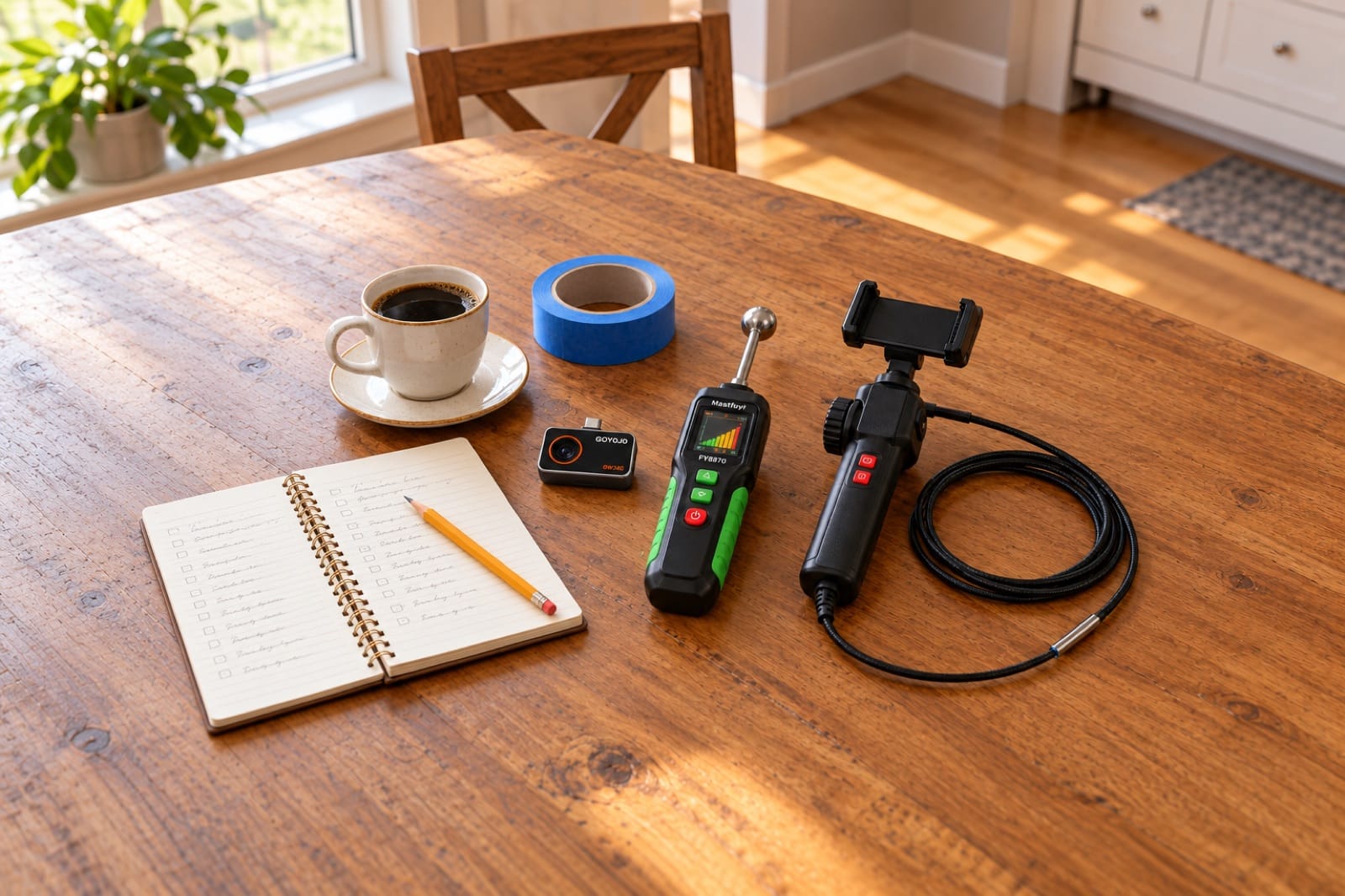
Thermal camera and moisture meter together
A thermal camera scans a whole room in seconds and shows the cold patches. Some are damp; some are just a draft or missing insulation. Touch the meter to each patch: if the number rises, it's water. That's the fastest way to find a leak behind a wall without opening it up — more in how to find a water leak behind a wall.